Who Made the First Candle? by M. J. Abadie
Although we have no historical record of the first candles used by humans, the oldest actual candle fragment ever found was unearthed by archaeologists near Avignon, France. The fragment has been dated to the first century A.D. It is the Romans who have been given credit for developing the wick candle. These Roman wick candles were used for lighting travelers on their way, illuminating homes and public places, and for burning at night in the temples and public places, especially those used for worship to Roman gods, though we know that the Romans also made use of torches, both for exterior and interior lighting. However, our knowledge of candles such as we know them today dates only to the European Middle Ages.
Most people gathered around the light provided by an open fire at night until the invention of oil lamps, or rushlights, which were the first primitive candles. With portable light, people could venture abroad to forage or hunt, or to nearby villages to trade or visit.
Necessity Is the Mother of Invention
There is an old saying that necessity is the mother of invention, and as we have seen, early candles were the product of inventiveness in response to necessity — long before electricity made such needs obsolete for much of the world (except, of course, in times of power outages, when we again must rely on candles, just like our ancestors!). We do not know for sure who invented the candle — there's not enough scientific evidence for proof — but we do know that the ancient Egyptians used rushlights for light. Rushlights were made by dipping grasses or reeds in melted tallow. Such “rush dips” were described by the Roman historian Pliny, and they had been quite common to countryfolk living in the villages of northern and central Europe until quite recently.
The Development of
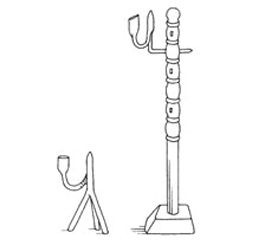
Rushlights by M. J. Abadie Rushlights or “rush dips” differ from modern candles because they are made without wicks. These first candle-like lights were probably made from stones or rocks that contained natural depressions. Animal fat would be put in the cup-like shape and a rush (a straw-like plant material) was pressed into the fat and lighted. In time, people learned to press oil out of fruits, nuts, and plants. For instance, in warmer climates such as Italy, olive oil was generally used. Another development was the extraction of oil from marine life. (See the description of candlefish in Chapter 2.) People began to craft lamps to hold the fat or oil and its rush, or wick. These were made of soft natural stone, like soapstone, or out of clay, beautifully made and decorated. In those days, people considered fire to be sacred and treated its containers with respect, devoting care to their making.Archaeologists have found lamps in nearly every dig. Ancient lamps have a small reservoir for the oil and a lip into which the wick was placed. Some were made of hard precious stone, such as quartz, serpentine, and lapis lazuli, suggesting that the candle's use was highly regarded.
Rushes, which could be found in abundance, could be peeled of their outer bark. The inside pith is a soft and absorbent fibrous material from which an excellent wick can be obtained. (In a pinch, if you were lost in the woods and had some fat or oil from your outdoor cooled meal, you could make your own rushlight.) The technique involved peeling the rush while leaving a strip of the outer bark attached so it would stand upright. Then, the rush was dipped into hot animal fat and cooled. This makes a rudimentary candle. By dipping the same rush into fat several times, you have quite a long-burning candle. A rushlight l5 inches long will burn for half an hour. Several of them will provide enough light to read by. For general illumination, they can be set upright — stuck in the ground or supported otherwise. A wonderful thing about rushlights was that they were cost-free. Anyone who butchered a pig or a sheep (and nearly everyone did) had plenty of fat available to make them. Even the poorest people could scrounge some rancid fat. They were smoky and smelly — but who cared?
Improvements Continue
The simple rushlights used by earlier people gradually evolved into a rather sophisticated (by the standards of the time) form of rushlight. As always, humans have experienced with the plant forms they found in their environment and turned them to various uses, including medicine and household conveniences, as well as for shelter and transportation.
|
|
|
|
||